How to Break Down and Collaborate on Complex Tasks: The Multi-Agent Workflow for AI Coding
First: you probably do not need multiple Agents
Suppose your frontend and backend are in one repository. You ask Codex or Cursor to add CSV export to the orders page. You explain the permission rule, the audit requirement, and how to verify the result.
One Agent can inspect the call path, change both sides, add tests, and run the application. For a small or tightly coupled project, this is normally the best way to work. It has one continuous context, no handoff, and no merge overhead.
You also do not need to care whether the product quietly uses an internal subagent. From your point of view, the important questions are still ordinary engineering questions:
- Did it understand the requirement?
- Did it change the right code?
- Did the tests and real user flow pass?
- Can you review what it did?
So why talk about multi-Agent workflows at all?
Because some tasks eventually stop behaving like one coherent piece of work. They become a queue of partly independent jobs: inspect two repositories, wait for a build, change an API, update a UI, prepare a migration, investigate security cases, and review the final patch. One Agent can still do them, but it must do most of them in sequence while carrying an increasingly noisy context.
Adding Agents is useful only if it removes one of those bottlenecks. It does not add wisdom by itself.
Can one Agent understand, implement, and verify the task in one clean loop?
├─ Yes → keep one Agent
└─ No, or too much time is spent waiting
   ├─ too much unrelated context → use a focused subagent
   ├─ independent work is queued → run workers in parallel
   ├─ repositories or environments differ → isolate sessions
   └─ the patch needs another viewpoint → use a reviewer Agent
That is the central idea of this article: one Agent is the default; multiple Agents are an optimization for a visible bottleneck.
What problem does another Agent actually solve?
Return to the order-export feature. The request looks small, but a mature product may need all of this:
- a button, progress state, and error handling in the UI;
- an authorized API that exports the same filters the user sees;
- an audit event containing the actor and request ID;
- tests for empty data, large exports, permissions, and client failure;
- enough logging to explain an incomplete export later.
A well-instructed Agent can handle the complete change. Start there.
Now imagine that the backend lives in one repository, the web app in another, and the database migration takes fifteen minutes to verify. A security review must also finish before release. At this point, one Agent spends a great deal of time switching context and waiting. The API and UI work could progress together; the reviewer could study the contract while builds run.
Another Agent can help in four practical ways:
It can work while the first Agent is busy. This is ordinary parallelism. It helps only when the work is genuinely independent.
It can keep noisy exploration out of the main conversation. A subagent can search a large repository, inspect logs, or compare test failures, then return a short conclusion with evidence.
It can work in another environment. A separate session or cloud Agent can use a different repository, branch, dependency set, or long-running machine without disturbing the main workspace.
It can review instead of author. A fresh Agent can read the final diff from the perspective of security, testing, or product acceptance. It is not guaranteed to be right, but it does not carry exactly the same working context as the author.
Every extra Agent also creates work: someone must explain the task, keep shared decisions aligned, inspect its output, and merge the result. If the feature takes twenty minutes to implement, coordination can easily cost more than it saves.
How several Agents cooperate without creating a mess
The useful mental model is not a group chat. It is a small delivery system.
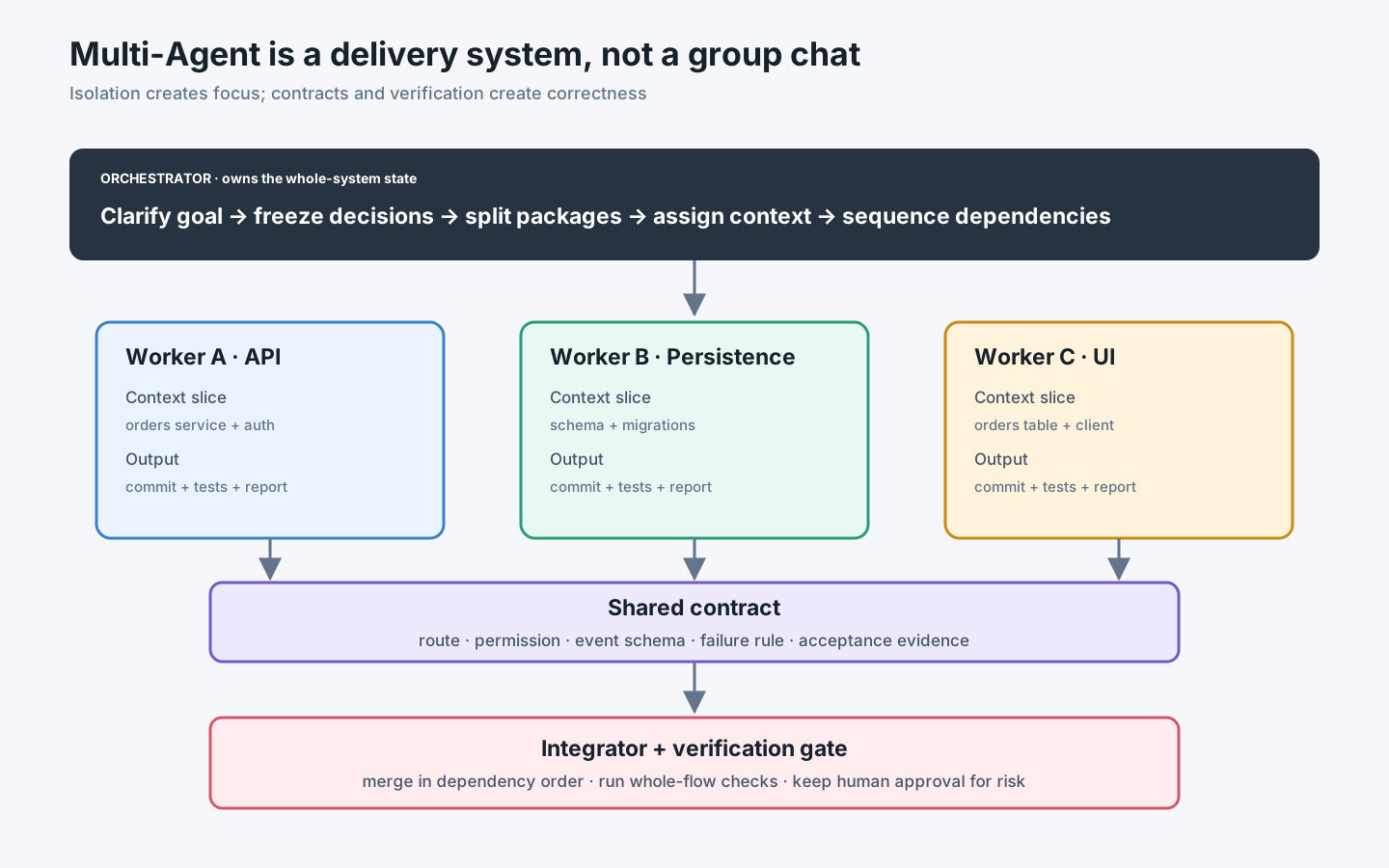
One role keeps the whole feature in view. Call it the orchestrator, lead, or primary Agent. It decides what can be separated, gives each worker enough context, and owns the final integration.
Workers receive bounded jobs. One may implement the API, another may prepare the migration, and another may design adversarial tests. They should not all improvise the product design independently.
The shared contract is the small set of decisions that every part must agree on. For the export feature it might be:
route: GET /api/orders/export
permission: orders:export
audit event: orders.exported
actor fields: actor_id, actor_type, request_id
success rule: do not record a successful export before the response starts
output: UTF-8 CSV with headers, including an empty result
The contract does not need to be a formal specification. A short Markdown file is enough. Its job is to stop the API worker, UI worker, and test worker from answering the same question three different ways.
Finally, one integrator brings the work together and verifies the complete behavior. Parallel implementation may save time; integration is still a whole-system responsibility.
A task worth splitting has visible seams
Do not divide work by file count. “You edit orders.ts; I edit export.ts” says nothing about responsibility.
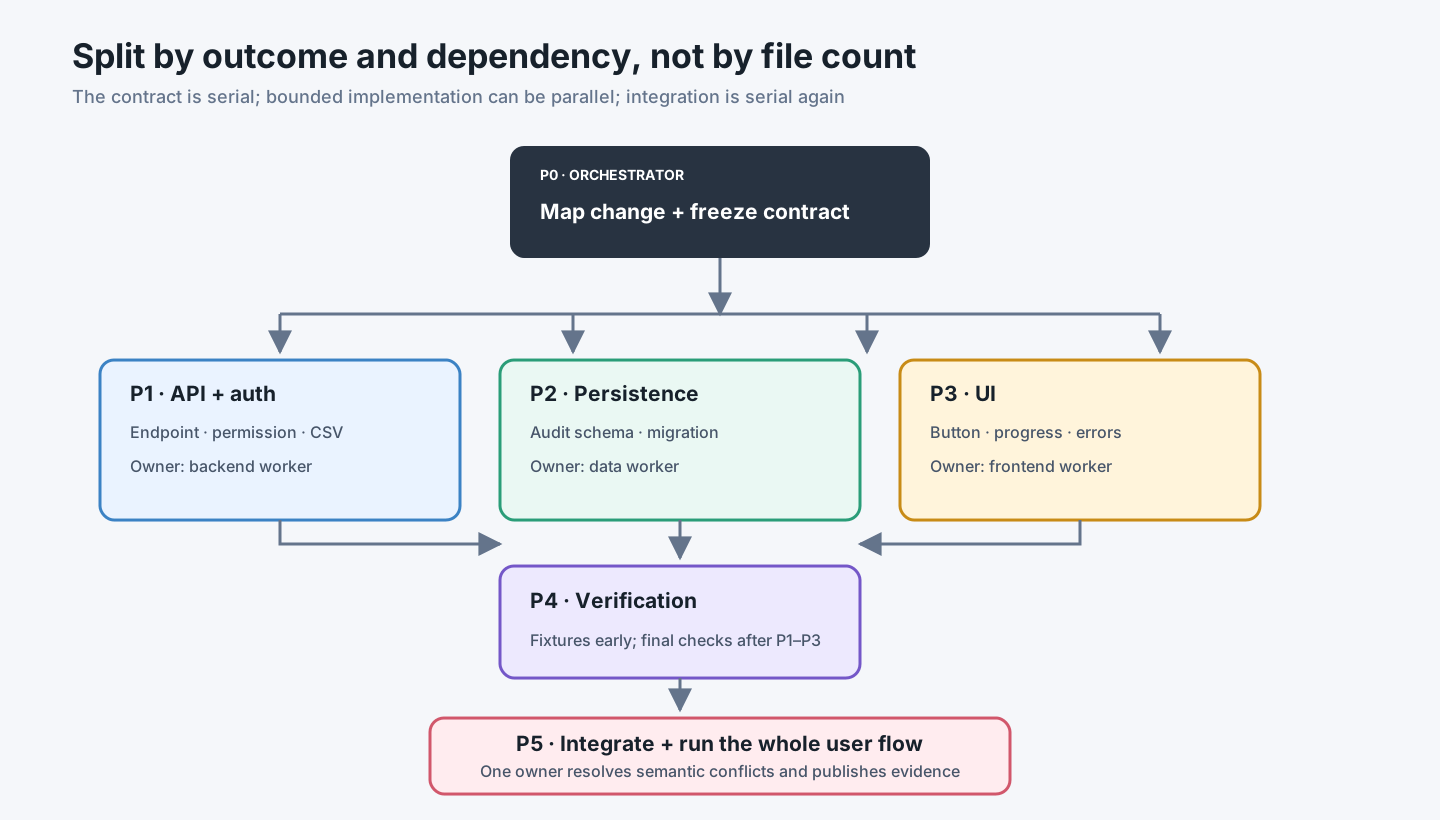
Split by outcomes that can be completed and checked separately. Our example could become:
P0  Understand the existing flow and agree on the contract
P1  Build the authorized export API
P2  Add the audit event and migration
P3  Add the UI flow
P4  Design cross-boundary and security tests
P5  Integrate and verify the real user journey
P1, P2, and P3 can begin after P0. P4 can prepare cases early, but it needs the implementation for its final run. P5 stays serial because this is where incompatible assumptions surface.
Three questions tell you whether a package is a good candidate for another Agent:
- Can it make useful progress without reading the entire repository?
- Can it return a durable result—a commit, report, contract, or test result?
- Can it avoid repeatedly editing the same files as another worker?
If the answer is no, keep the work together. An unclear production deadlock, for example, should usually stay with one investigator until there is evidence to split into narrower experiments. Five Agents producing five guesses are not a team; they are a larger pile of uncertainty.
Give a worker a job it can finish
“Handle the backend” is a poor handoff. The worker does not know what it owns, what it may change, or what counts as done.
A useful work request can still be short:
Implement the authenticated order-export endpoint.

Read:
- `services/orders/`
- the existing authorization middleware
- `docs/orders-export.md`

Do not change the frontend or the audit schema.

Done means:
- unauthorized callers receive the standard 403 response;
- empty results return a CSV with headers;
- focused tests pass;
- you return the commit, commands run, results, risks, and open questions.
The last line matters. “Done” is not useful unless the next person can see what changed and how it was checked.
For longer work, ask each worker to leave a compact report:
# API handoff
- Commit: abc1234
- Changed: export controller, service, tests
- Contract used: docs/orders-export.md
- Verified: pnpm test orders-export → 12 passed
- Remaining risk: client disconnect during streaming is not covered
- Open questions: none
This is much more useful than copying a full conversation. A transcript contains every search, false start, and guess. A handoff should contain the conclusion, evidence, and unresolved risk.
A practical workflow from request to merge
The entire process can stay simple.
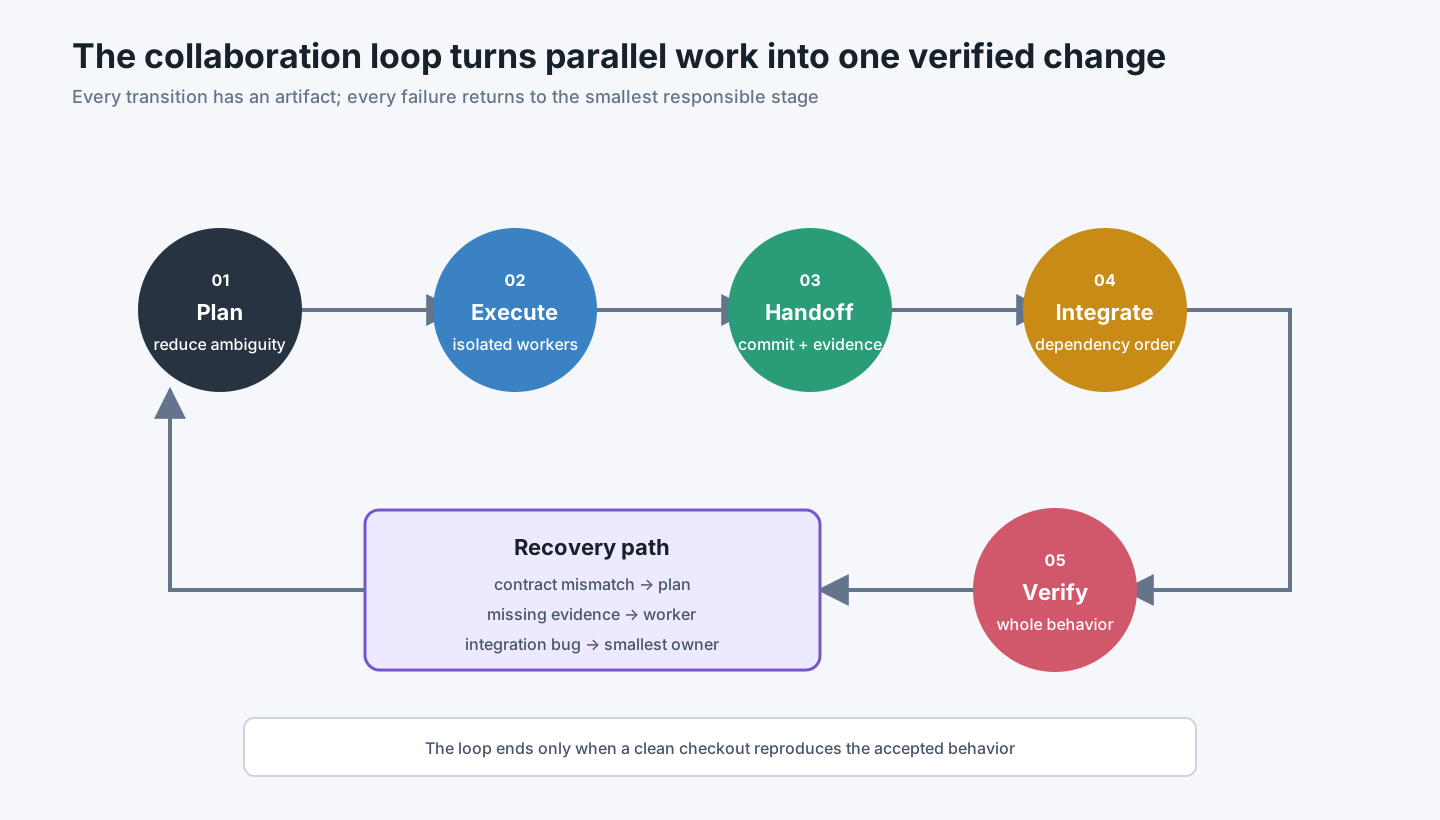
1. Let one Agent understand the whole change first
Before parallel coding, ask the primary Agent to map the current behavior:
Find the order-filter path, authorization boundary, migration convention,
UI entry point, and verification commands. Propose the smallest shared
contract and identify decisions that need a human answer. Do not edit yet.
This may feel slower than launching three workers immediately. In practice it prevents all three from discovering a different “main” order query.
2. Parallelize only the parts that are ready
Once the route, permission, event name, and success rule are settled, the API, persistence, and UI packages can work independently. Exploration and test design are also good parallel jobs because they tend to produce reports rather than overlapping edits.
Keep unstable decisions, shared schema changes, conflict resolution, and final end-to-end verification under one owner.
A useful rule is: before integration, each file should have one editing owner. A second Agent can review or test the file, but two workers should not continually rewrite it.
3. Integrate by dependency, not by finish time
The first branch to finish is not necessarily the first one to merge. For this feature, the integrator might merge the migration and contract tests, then the API, then adapt the UI to the actual response, and finally add the cross-boundary tests.
When Git reports a conflict, read the contract before choosing lines. Many merge conflicts are really design disagreements with a familiar interface.
4. Ask a fresh Agent to review the complete diff
The reviewer should not receive “looks good?” as its entire task. Give it the acceptance criteria and ask focused questions:
Review the merged change without editing it.
Check authorization, audit accuracy, CSV injection, large-result behavior,
client disconnects, and route consistency. For every finding, show the file,
the violated requirement, and the smallest reproducible check.
Then a human still decides what matters. Two Agents using similar models can share blind spots, especially around business rules that are not written down.
Where Codex, Cursor, and Claude Code fit
The engineering pattern is more important than the product name. Keep the contract, commits, and verification evidence portable; use each tool for the runtime it provides.
In Codex, a primary Agent can delegate focused work to subagents while keeping responsibility for the whole task. Worktrees or separate tasks are useful for long-running edits. If you need a durable automated workflow rather than an interactive session, the Codex SDK can be used as the orchestration layer. The official documentation also covers Codex subagents and worktrees.
In Cursor, Subagents are a good fit for focused exploration, testing, or implementation that should not flood the parent conversation. Cloud Agents are more useful when work needs an isolated machine, separate branch, parallel execution, or several repositories.
In Claude Code, custom subagents can represent recurring roles such as API builder, test designer, or security reviewer. Separate sessions and worktrees isolate concurrent edits. Agent Teams add shared tasks and direct communication between sessions, but the official documentation currently labels the feature experimental, so durable branches and reports remain a sensible fallback.
You do not need to learn all of these mechanisms before using the tools. Begin with one Agent. Learn subagents when context becomes noisy, worktrees when concurrent edits collide, and team orchestration when the simpler forms have become a real limitation.
When multi-Agent work goes wrong
The most common failure is splitting too early. If the route, data shape, and success rule are still changing, every worker builds against a moving target. Stop the parallel work, settle the shared decision, and restart the affected packages.
The second failure is overlapping ownership. If everybody edits the same files, extra Agents create merge work rather than useful work. Restore one owner and turn the other workers into reviewers or test authors.
The third failure is a weak handoff. “Done” without a commit, test result, or known risk forces the integrator to repeat the investigation. Treat missing evidence as unfinished work.
The fourth failure is treating an Agent as an access-control boundary. A prompt saying “do not deploy” does not prevent deployment. Restrict credentials and tools, use pre-execution gates where the host supports them, and enforce production permissions in GitHub, cloud platforms, databases, and registries.
And sometimes the workflow is simply slower. That is useful feedback. Collapse the packages and return to one Agent.
A small checklist before you split a task
Ask yourself:
- What is the bottleneck I expect another Agent to remove?
- Which decisions must everyone share?
- Can each worker return a commit or evidence that stands on its own?
- Will workers avoid editing the same files?
- Who owns the final merge and end-to-end check?
- Is the expected time saved greater than the coordination and review cost?
If you cannot answer those questions, do not split yet.
Multi-Agent AI Coding becomes useful when a task has grown beyond one clean execution loop. Its real advantage is not that several models are inherently smarter than one. It is that independent work can happen at the same time, noisy contexts can stay separate, environments can be isolated, and the final patch can receive a fresh review.
For everything else, one careful Agent with a clear requirement and a real verification loop remains an excellent choice.