How Good Is an AI Coding Model? From Benchmarks to a Real Project Trial
Two models, six leaderboards, and still no answer
You are choosing a model for Claude Code, Codex, Cursor, or an internal coding Agent. Search for advice and you will quickly find claims such as:
- Model A leads a coding leaderboard.
- Model B feels better for frontend work.
- Model C is slower but stronger at reasoning.
- Model D is cheaper and therefore has better “value.”
The numbers look precise, yet they do not answer the practical question:
We mostly fix bugs, change APIs, and add tests. Which model will produce changes we can actually merge?
To answer that, we first need to make the word benchmark ordinary. Then we will learn how to read the major score sites without mixing incompatible numbers. Finally, we will build a small trial from your own completed engineering tasks.
1. A benchmark is an exam for a model or Agent
A benchmark is not magic. It normally contains three things:
a set of questions or tasks
+ the same exam rules for every candidate
+ a way to grade the result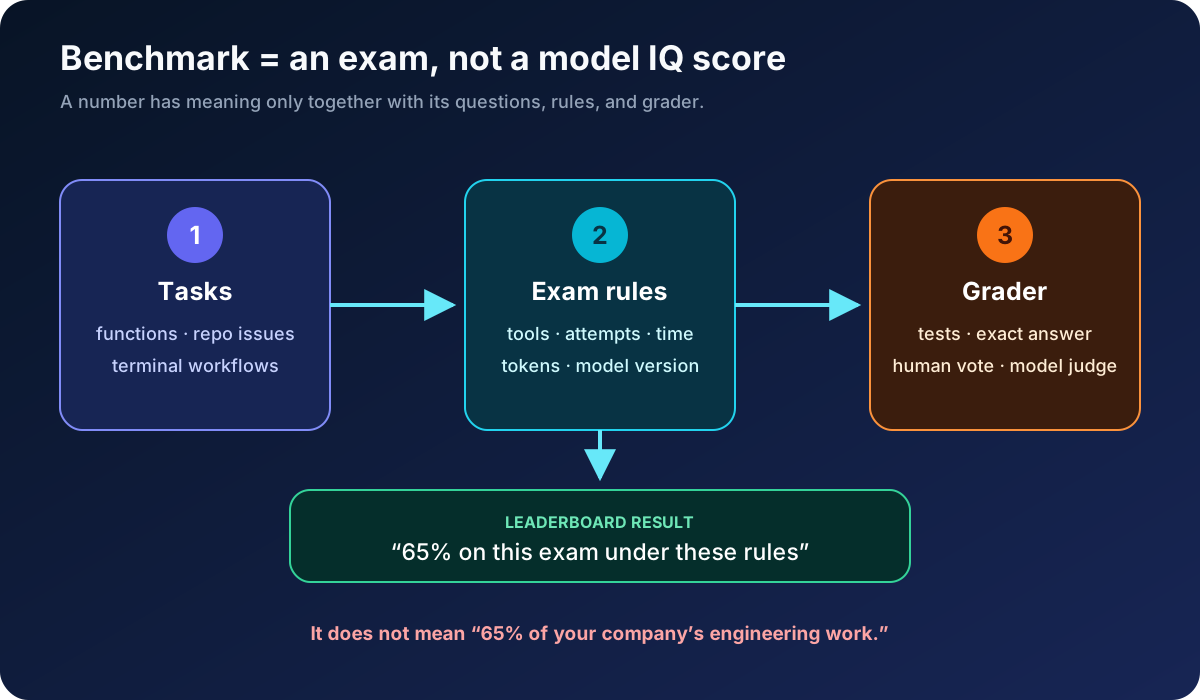
Imagine 100 small programming tasks. Each one describes a function to write. The model produces code, hidden tests run, and a passing solution receives credit. If it solves 65 tasks, the reported score may be 65%.
That does not mean the model can finish 65% of your company’s work. It means it achieved that result on those questions under those rules.
The benchmark and the leaderboard are different things
The benchmark is the exam. The leaderboard is the score sheet.
| Candidate | Score | Cost shown | What we still need to know |
|---|---|---|---|
| Route A | 72% | high | Which Agent and how many attempts? |
| Route B | 68% | medium | Same task set and budget? |
| Route C | 55% | low | Was it tested recently? |
The leaderboard helps you form a shortlist. The method tells you whether the comparison is fair for your decision.
pass@1 is not pass@5
You will often see labels such as pass@1 and pass@5.
pass@1asks whether the first submitted solution works.pass@5gives the model several samples and asks whether at least one works, usually with a statistical estimator over repeated samples.
The original HumanEval research showed how strongly repeated sampling can change the result. That is useful when a product can generate and test many candidates. It is not the same experience as paying for one attempt and reviewing one patch. Never compare a pass@5 number directly with somebody else’s pass@1.
2. Different coding benchmarks give different exams
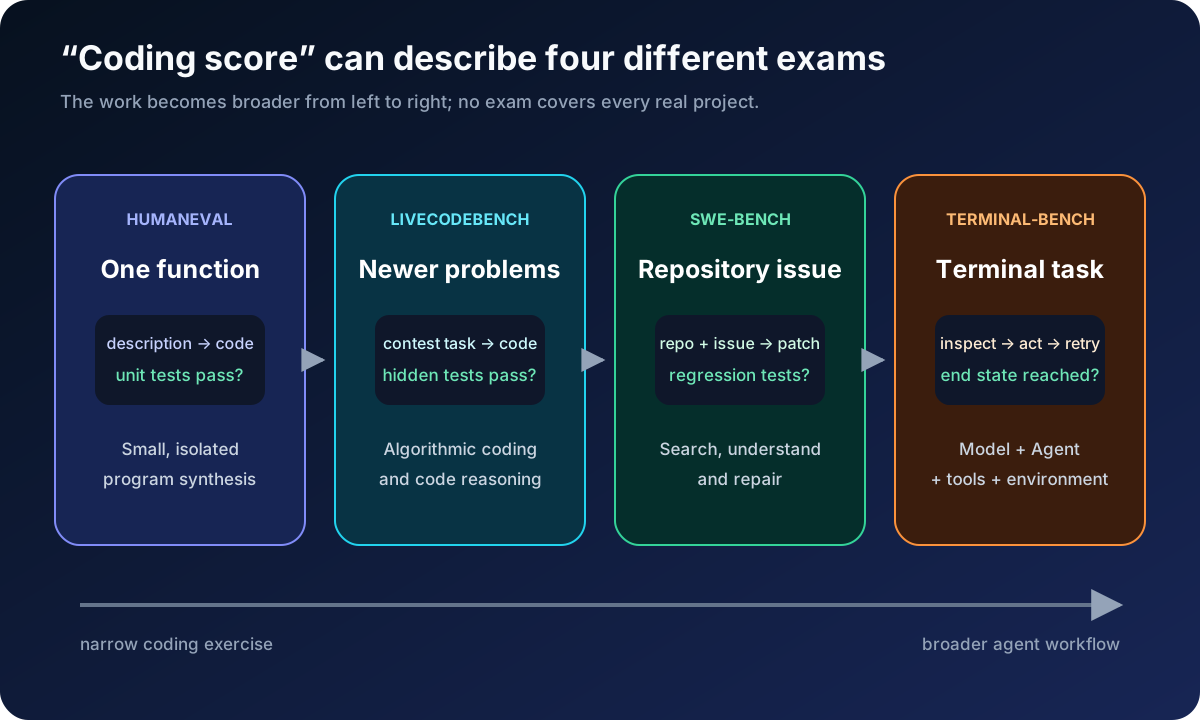
“Coding score” is too vague. These common benchmarks test increasingly complete kinds of work.
HumanEval: write a small function
HumanEval was introduced to measure functional correctness when generating programs from docstrings. A task resembles a self-contained coding exercise: read a function description, implement it, and pass tests.
It is easy to understand and automate. It does not ask the model to explore a large repository, interpret an ambiguous product request, or recover from a broken build.
LiveCodeBench: solve newer contest problems
LiveCodeBench continuously collects programming-contest problems and versions the dataset by publication date. Its maintainers test code generation as well as related abilities such as execution, self-repair, and predicting test output. The changing time window is intended to reduce the chance that an old public problem has simply appeared in training data.
This is useful evidence for algorithmic coding and code reasoning. A contest problem is still cleaner and more self-contained than maintaining a company service.
SWE-bench: repair a real repository issue
SWE-bench gives an Agent a real GitHub repository and issue description, then asks it to produce a patch. Tests determine whether the issue was fixed without breaking expected behavior. The official project describes SWE-bench Verified as a human-validated subset and uses containerized environments for reproducible evaluation.
This is much closer to fixing a repository bug. It still reflects the repositories, languages, issue quality, test harness, and Agent setup chosen by the benchmark—not your private codebase.
Terminal-Bench: complete a task through a terminal
Terminal-Bench evaluates Agents in terminal environments. A task may require inspecting files, running commands, configuring software, debugging failures, and verifying an end state.
Now the score depends on more than the model’s answer. The Agent’s tools, command loop, environment, timeout, and recovery behavior matter too.
Put simply:
HumanEval       → Can it write this function?
LiveCodeBench   → Can it solve newer programming problems?
SWE-bench       → Can it repair this repository issue?
Terminal-Bench  → Can this Agent finish a terminal task?
A score is meaningful only after you know which question it answers.
3. Where can you see credible, current model comparisons?
The links below were checked on August 17, 2026. The rankings and supported models will change, so this article deliberately does not copy a “current top ten.” Open the live site and read its method next to the score.
| Site | Who maintains it | Best used for | Do not conclude that… |
|---|---|---|---|
| SWE-bench Leaderboards | Benchmark maintainers | Repository issue resolution by model-and-Agent systems | the top entry is the best model in every coding client |
| Terminal-Bench Leaderboards | Terminal-Bench/Harbor maintainers | End-to-end terminal Agent tasks | the score measures only the underlying model |
| LiveCodeBench Leaderboard | Research project maintainers | Recent algorithmic coding and code reasoning | contest performance proves repository-maintenance quality |
| Aider LLM Leaderboards | Aider project | Code editing inside the Aider setup; its Polyglot benchmark covers several languages and reports cost | the same model will get the same result in Codex or Claude Code |
| METR Time Horizons | METR research nonprofit | How success changes with task length in its software-heavy task suite | an “8-hour horizon” means eight hours of any professional’s normal work |
| LMArena | Community evaluation platform | Which anonymous response people prefer in pairwise comparisons | preference equals functional correctness or test passage |
| Artificial Analysis | Independent commercial benchmark publisher | One place to compare quality, price, latency, throughput, and disclosed composite methods | its overall Intelligence Index is your coding score |
This table mixes three kinds of evidence on purpose:
- maintainer or research leaderboards tell you how candidates performed on one defined test;
- human-preference arenas tell you what users preferred in side-by-side output;
- comparison aggregators make price, speed, and multiple tests easier to scan.
They are all useful. They are not interchangeable.
Artificial Analysis, for example, publishes the weights and constituent evaluations behind its composite Intelligence Index and separately exposes performance and price measurements. That transparency makes the site useful for shortlisting. The overall number still combines categories according to its priorities, not yours.
LMArena uses votes on anonymous model responses to build rankings. That can reveal which answers people find more helpful or appealing. A pleasant explanation can win a preference vote even when neither answer has been executed against your test suite.
4. The same model can behave differently in different coding tools
Think of the model as an engine. Claude Code, Codex, Cursor, Aider, and other Agents are complete vehicles built around it.
The coding tool decides:
- which project rules and files enter context;
- how repository search works;
- which shell, browser, or MCP tools are available;
- how tool results are returned to the model;
- when history is compacted;
- how often a failed step is retried;
- how long the task may run.
Therefore, many modern leaderboards are really comparing a complete route:
model version + Agent + tools + instructions + budget + graderThis is why the previous article treated a gateway route as more than a model name. Evaluation should do the same. A great SWE-bench Agent result does not guarantee that the bare model, used through another client with another tool loop, will reproduce it.
5. Six questions to ask before trusting a leaderboard row
Do not start with first place. Open the methodology and ask:
1. What work was tested?
Small functions, contest problems, GitHub issues, terminal administration, or human preference all answer different questions.
2. What exactly competed?
Was it a model API, a coding Agent, or a product with retrieval, tools, and retries?
3. Which model version and date?
An alias can move. A pinned snapshot and an evaluation date are easier to reproduce.
4. How many attempts were allowed?
First-try success, two editing rounds, and hundreds of sampled solutions have very different cost and user experience.
5. What time, token, and tool budget was available?
A higher score purchased with much more time or many more tokens may still be a good choice—but it is a different choice.
6. How was success graded?
Hidden tests, exact answers, an LLM judge, and human votes each capture something different. OpenAI’s official evaluation best-practices guide likewise recommends combining metrics with human judgment, making tests task-specific, and calibrating automated scoring against human feedback.
Keep this compact reading card:
task · candidate · version · attempts · budget · grader · dateIf two rows differ on several of these fields, their percentages may not be directly comparable.
6. Why the leaderboard winner may lose in your repository
The public exam may contain:
- well-specified Python issues from open-source repositories;
- a clean container and known test commands;
- hidden tests that decide pass or fail;
- a fixed time budget with no product meeting or reviewer discussion.
Your job may contain:
- a Java, Go, PHP, or multilingual monorepo;
- internal frameworks absent from public training data;
- a two-sentence requirement with missing decisions;
- no regression test until the Agent writes one;
- permission, data, and release rules;
- a reviewer who cares about scope and maintainability.
METR makes a similar boundary explicit for its time-horizon results: its tasks are mostly self-contained, clearly specified software, machine-learning, and cybersecurity work. Its FAQ warns that these are closer to what a capable but low-context contractor could do than what an experienced teammate does with years of project knowledge.
Public scores remain valuable. They tell you which candidates deserve a trial. Your repository decides the job offer.
7. One bug shows what “success” really means
Consider this task:
CSV exports containing Chinese text appear garbled when opened in Excel. Find the cause, fix it, and add a regression test.
Two hypothetical model routes receive the same repository snapshot, request, project rules, tools, and time limit.
Route A
It quickly finds the export code and changes the application’s global response encoding. The new test passes, but unrelated downloads now inherit the behavior. Review requests a rewrite.
Route B
It inspects the export path and existing tests, changes only the CSV response, and adds a focused regression test. The patch is smaller and passes review.
| Check | Route A | Route B |
|---|---|---|
| Garbling fixed | Yes | Yes |
| Automated tests pass | Yes | Yes |
| Change stays within the requested path | No | Yes |
| Obvious collateral risk | Yes | No |
| Human rework required | Yes | No |
| Ready to merge | No | Yes |
If the grader checks only the new test, both routes “pass.” Engineering success is stricter:
requirement met
+ tests pass
+ no unacceptable side effects
+ review accepts the change
8. Run your own useful trial with 10–20 old tasks
You do not need an evaluation platform to begin.
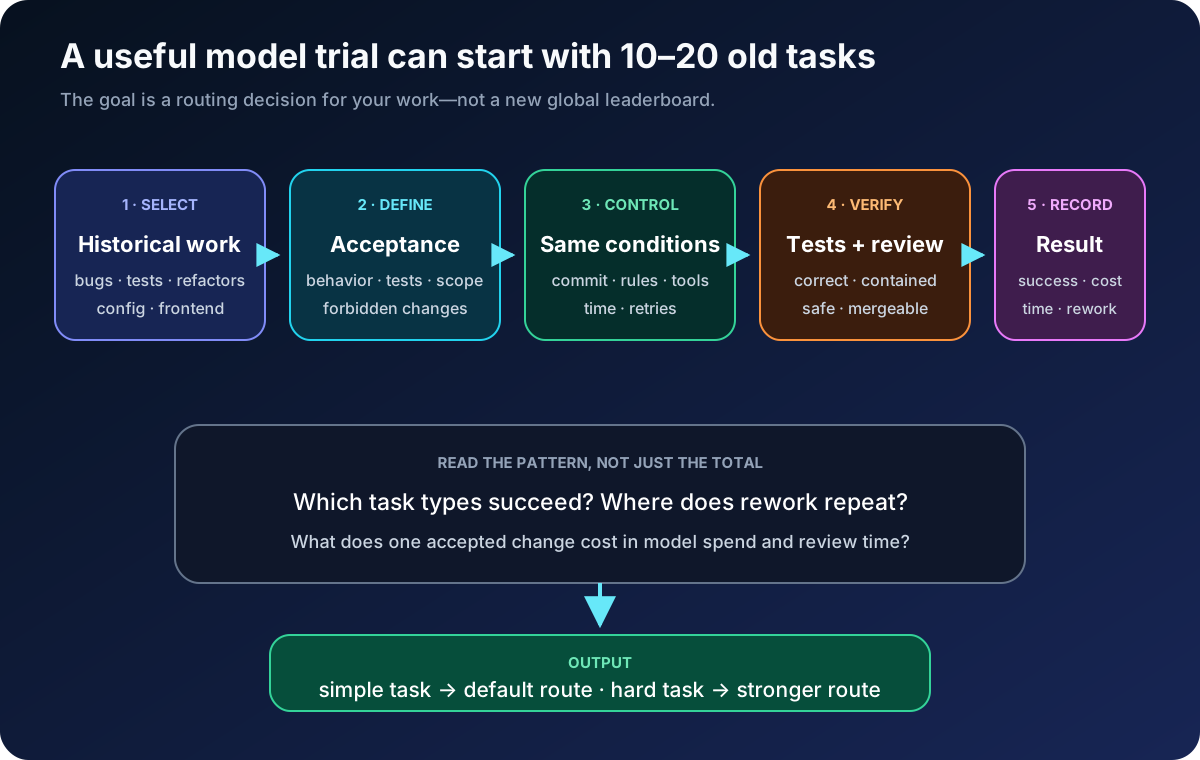
Step 1: choose completed work, not invented puzzles
Select a small, representative set from recent issues and pull requests:
- three simple bug fixes;
- three cross-file changes;
- two regression-test tasks;
- two refactors that must preserve behavior;
- two dependency, configuration, frontend, or browser problems common to your team.
Ten to twenty tasks will not produce a universal scientific ranking. They can expose large mismatches before you move an entire team.
Step 2: write acceptance criteria
For the CSV task:
1. Chinese content opens correctly.
2. Existing export behavior remains intact.
3. A regression test is added.
4. Unrelated download handlers are not modified.
5. The full relevant test suite passes.
Step 3: hold the exam conditions constant
Use the same:
- repository commit;
- task description;
- project rules;
- tools and permissions;
- time limit;
- retry or turn limit.
Record the exact model and client version. If one route gets browser access and three retries while another gets neither, you are not isolating the difference you think you are measuring.
Step 4: keep a small result sheet
| Task | Accepted? | Tests | Rework needed? | Runtime | Model cost | Review minutes |
|---|---|---|---|---|---|---|
| CSV encoding | yes | pass | no | 12 min | recorded | 5 |
| Permission bug | no | fail | yes | 25 min | recorded | 18 |
| Regression test | yes | pass | no | 8 min | recorded | 4 |
Do not rush to create one weighted “intelligence score.” First answer:
- How many tasks produced an acceptable patch?
- Which task types repeatedly required rework?
- What did one accepted change cost in model spend and review time?
Step 5: repeat important tasks
Model output varies. Run high-value tasks two or three times. Look for routes that occasionally make dangerous changes, costs that swing widely, and failures that cannot recover—not just the best single run.
9. Do not let your internal test become another misleading leaderboard
Common mistakes are surprisingly ordinary:
- choosing only five easy tasks;
- giving one candidate clearer instructions;
- comparing one attempt with a multi-attempt result;
- treating a flaky test as a model failure;
- counting “code produced” as “task completed”;
- tuning instructions repeatedly against the same visible tasks;
- hiding failures and reporting only the best run;
- ignoring review time because it is not on the API invoice.
Use deterministic evidence first: tests, type checks, linters, security checks, forbidden-path checks, and the final diff. Use a short human rubric for scope, maintainability, and risk. An LLM judge can help at scale, but it should be checked against human labels; model judges can prefer longer answers or be biased by response order.
For a small team, the minimum discipline is enough:
same snapshot · same rules · same budget · repeat runs · tests + review10. The result is usually a routing rule, not one champion
Your trial may show that:
- a low-cost route is reliable for search, summaries, and simple tests;
- a default route handles ordinary features and bugs;
- a stronger route is worth its cost for cross-module debugging;
- permission, data, and security changes still require a human gate.
That becomes a practical policy:
search and boilerplate       → economical route
ordinary feature or bug      → default route
complex diagnosis            → stronger route
sensitive change             → stronger route + human approval
repeated failure             → explicit escalation, not silent looping
This is where evaluation meets Gateway governance. The gateway should not route by marketing rank; it should route by evidence from the work your team actually performs.
11. When should you run the trial again?
Old results may no longer apply when you change:
- the model snapshot or reasoning setting;
- Claude Code, Codex, Cursor, Aider, or another Agent;
AGENTS.md, project Rules, or the system prompt;- shell, browser, MCP, or search tools;
- context compaction, token budget, timeout, or retry limit;
- Gateway routing or fallback behavior;
- the repository’s main language or architecture.
You do not need to rerun everything for every small edit. Keep a fast smoke subset, run the fuller set before changing the default route, then canary the candidate with low-risk work. The OpenAI evaluation guide describes evaluation as a continuous process: define success, collect relevant data, choose metrics, compare results, and keep adding real failure cases.
Verification checklist
Before choosing a model route, can you answer:
- What tasks does the public benchmark contain?
- Is the row a bare model, an Agent, or a complete product setup?
- Are the version, date, attempts, budget, and grader visible?
- Are you comparing
pass@1withpass@1? - How does the public task differ from your languages and repositories?
- Have you selected 10–20 completed internal tasks?
- Does every task have acceptance criteria and a fixed repository snapshot?
- Do you record tests, rework, cost, runtime, and review time?
- Have important tasks been repeated?
- Can the result become a simple, explicit routing rule?
Benchmarks find candidates; project trials make decisions
A benchmark is an exam. It is useful because every candidate faces a defined task and scoring method. It becomes misleading only when we forget what the exam contained.
Use current leaderboards to understand the field. Read the method before the rank. Then give promising candidates a small, fair trial in your own work.
The question changes from “Which model is number one?” to:
Which model route reliably produces acceptable changes for this kind of task, at a cost and risk we are willing to own?
That answer is less exciting than a global leaderboard. It is much more useful to a team.
Authoritative references
- HumanEval paper: Evaluating Large Language Models Trained on Code — functional code generation and repeated sampling.
- SWE-bench official repository and leaderboards — real repository issues, evaluation harness, and maintained results.
- LiveCodeBench official repository and leaderboard — time-versioned coding problems and code-capability scenarios.
- Terminal-Bench leaderboards — terminal Agent task comparisons.
- Aider LLM Leaderboards — code-editing results, cost, commands, versions, and Polyglot task details.
- METR Task-Completion Time Horizons — task-length methodology and explicit interpretation limits.
- OpenAI evaluation best practices — task-specific evals, human calibration, graders, and continuous evaluation.
- LMArena and Artificial Analysis methodology — human-preference and independent composite comparisons, respectively.